Running AI in Your Azure Cloud: Why Zero Data Egress Matters
August 10, 2026
Somewhere in your organization right now, a security architect is reviewing an AI vendor's questionnaire. Where is data processed? Who holds the encryption keys? What's the data retention policy? Which subprocessors are involved? The review takes weeks. Sometimes it ends in a no. Often it ends in a yes with restrictions that make the tool half as useful.
The problem isn't that security teams are obstinate. It's that nearly every AI platform makes the same architectural demand: send us your data.
There's another way to structure this entirely.
Deployment model is the security posture
Findable deploys inside your Azure tenant. Not "hosted in Azure by us" — deployed in your subscription, on your infrastructure, governed by your policies. That single decision resolves most of the questionnaire before it's asked.
Identity is your identity. Authentication runs through your Microsoft Entra ID — same SSO, same conditional access policies, same group structure. Role-based access control applies at the app, page, and entity level, driven by the Azure AD groups you already maintain. External users are blocked by policy, not promise.
Storage is your storage. Conversations and metadata live in your Cosmos DB. Files live in your Blob Storage. Search indexes live in your Azure AI Search, with ACL-based security trimming so results respect the same permissions as the source documents.
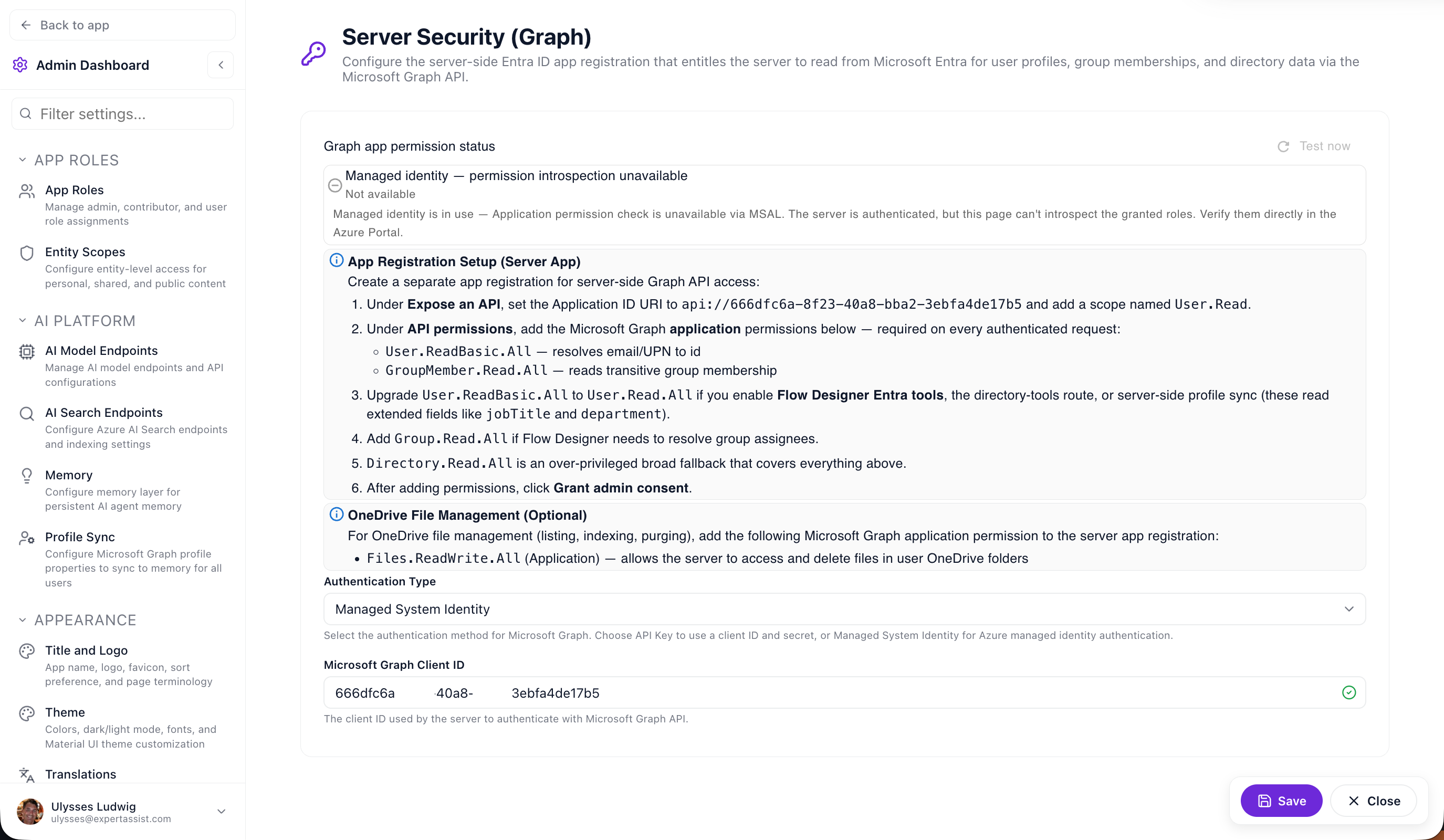
Secrets barely exist. Managed Identities authenticate the platform to your Azure resources and databases — no stored credentials to rotate, leak, or audit.
Nothing leaves. Zero data egress isn't a contractual assurance; it's an architectural property. There is no vendor cloud for your data to travel to.
Governance is what makes AI usable, not just safe
A common misconception: security features constrain what AI can do. In practice, they're what allow AI to touch anything important at all.
Findable's data-chat capability is the clearest example. Users query 27 database platforms — SQL Server, PostgreSQL, Snowflake, Databricks, Microsoft Fabric, BigQuery, MongoDB, and more — in plain English. That's only deployable because the layer underneath enforces read-only, SELECT-only access, blocks dangerous SQL patterns outright, masks sensitive fields, and logs every query. The governance isn't a brake on the feature. It's the reason the feature is allowed to exist.
The same logic runs through the platform: every conversation is logged and auditable, every flow execution is tracked, every human approval leaves a trail. When your compliance team asks "what did the AI do and who authorized it," there's an answer.
The question to ask any AI vendor
If you're evaluating enterprise AI platforms, one question sorts the field quickly: "Can this run entirely inside our tenant?"
Most vendors will answer with a paragraph about their SOC 2 certification, their encryption standards, and their data processing agreement. Those things matter — for architectures that need them. An AI platform that runs in your cloud, on your identity, with your storage, simply has less to prove. Your security team isn't extending trust to a new vendor. They're reviewing an Azure deployment, which is something they already know how to do.
That's the review that ends in weeks, not quarters — and in a yes.
Findable: enterprise AI that lives in your cloud. Deployed in your tenant, always. Request a demo or review our security page.