AI With Memory: Why Stateless Assistants Fail in the Enterprise
August 3, 2026
Every conversation with a stateless AI assistant starts the same way: you re-explain your project, your preferences, your constraints, and your organization's conventions. Then the conversation ends, and all of it evaporates.
For a consumer chatbot, that's an annoyance. For an enterprise platform, it's disqualifying. If a hundred employees each spend five minutes a day re-establishing context, you're burning meaningful hours on conversational throat-clearing — and getting inconsistent results, because the AI's understanding resets to zero every session.
The fix isn't "longer context windows." It's memory with structure and governance.
One distinction before going further, because the two are often conflated: conversation history is the verbatim record of what was said in each chat. Memory is what's worth keeping from it — distilled facts and preferences, scoped, weighted, and retrievable in every future conversation. They work together, but history is a transcript; memory is understanding.
Memory is a scoping problem
The naive version of AI memory — remember everything, globally — fails immediately in an organization. Some context belongs to one person. Some belongs to a team's workflow. Some is organizational knowledge that everyone should benefit from. And some must never leak across those boundaries.
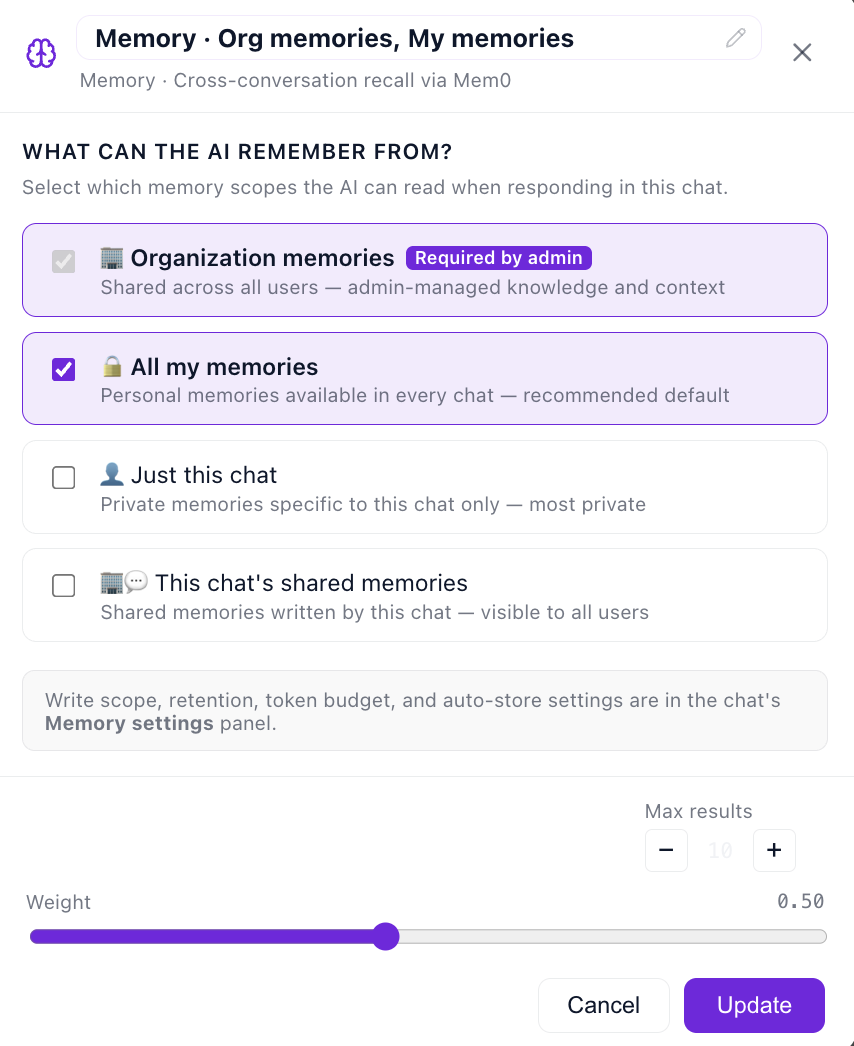
Findable's memory system (built on Mem0) addresses this with six distinct scopes:
- User Global — an individual's preferences and context, everywhere they work
- Org Global — shared organizational knowledge available to all users
- User Flow / Org Flow — context scoped to a specific workflow, per-user or shared
- User Chat / Org Chat — context scoped to a conversation surface
A business analyst's preferred metrics and reporting format follow them across conversations (User Global). The organization's fiscal calendar and naming conventions inform everyone's queries (Org Global). An onboarding workflow remembers each new hire's progress (User Flow) without contaminating anyone else's.
In practice, users see this as a simple choice in every chat: which scopes can the AI read from, how many memories to retrieve, and how heavily to weight them — while admins can require organization-wide context to always be present.
Governance makes memory safe
Memory in an enterprise raises immediate questions: Where is it stored? Who controls it? What about compliance?
The answers here are configurable rather than assumed. Retention windows, token budgets, and retrieval strategies are admin-controlled. Scopes can be locked for compliance — if your policy says no organizational memory, an admin turns the scope off. And backends are pluggable: cloud-hosted or fully self-hosted, keeping memory inside your tenant like everything else in Findable.
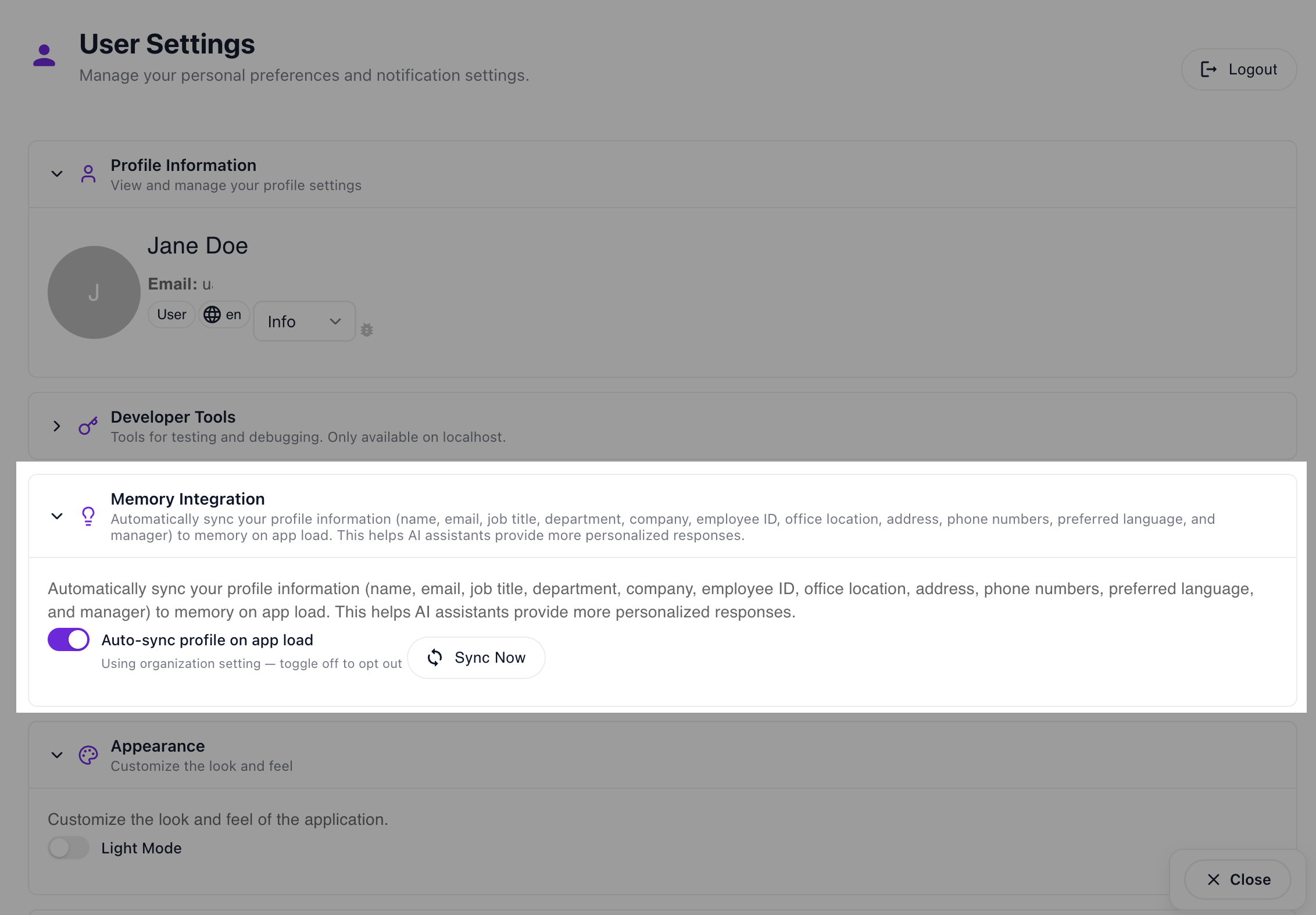
Consent works the same way: organization policy can sync profile context into memory by default, and every individual keeps a visible opt-out. Governance and personal control aren't in tension — they're the same panel.
What durable context changes
Memory compounds. The first week, the AI stops asking your name. The first month, it stops asking how your team formats reports. By the first quarter, workflows are informed by every previous run — the incident-response flow knows which past incidents resembled this one; the vendor-evaluation flow recalls how similar vendors scored.
That's the difference between an AI tool and an AI colleague: one starts from zero every morning.
Findable's memory runs inside your Azure tenant with the rest of the platform — 6 scopes, configurable retention, admin-controlled compliance locks. Request a demo.