Beyond LangGraph: What Enterprise AI Workflows Actually Need
July 27, 2026
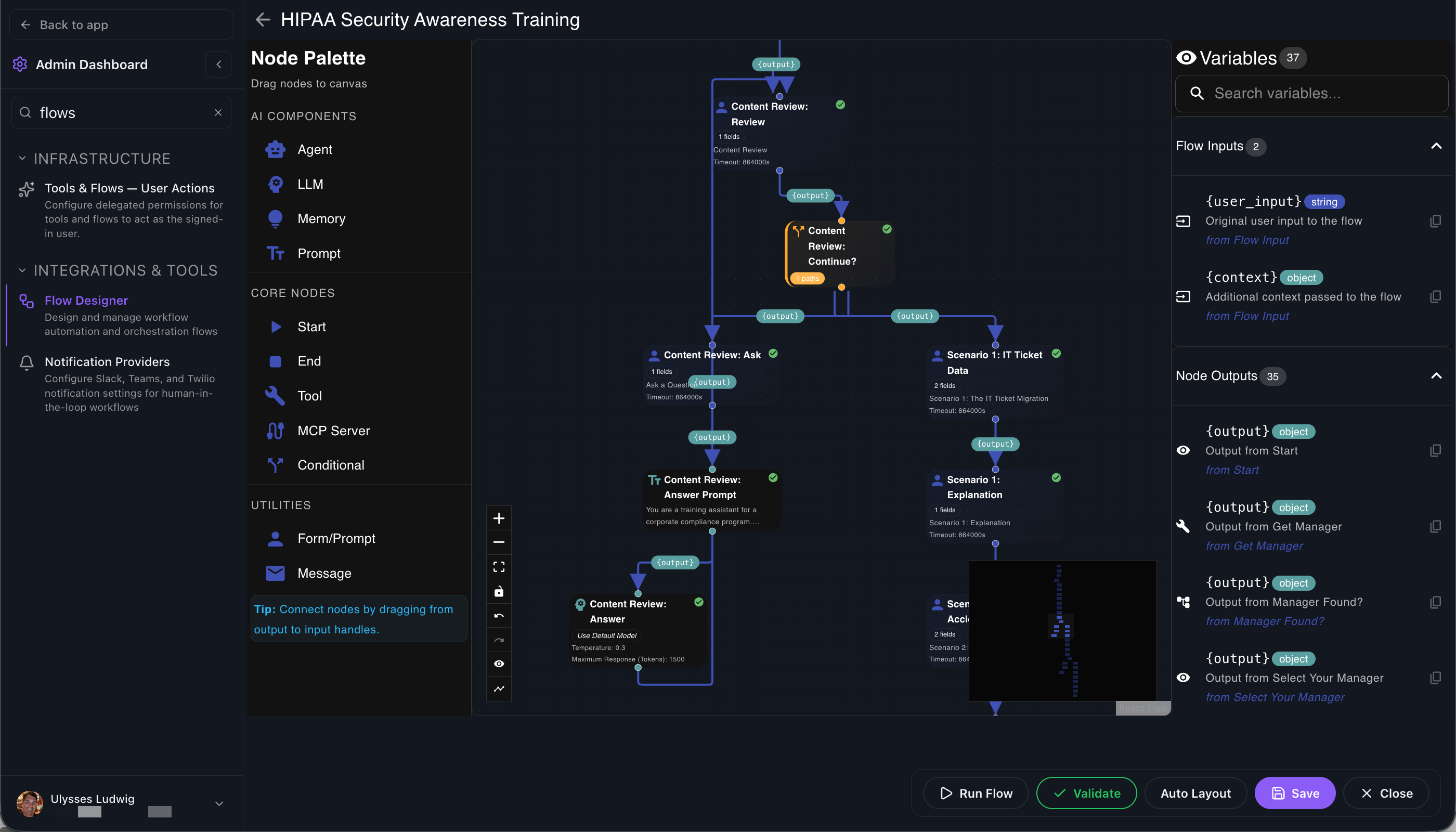
Let's start with credit where it's due: LangGraph is a well-designed framework. If you're a developer building a bespoke agent system, its graph model, state management, and interrupt/resume primitives are solid foundations. We know because we studied it closely.
But a framework is not a platform, and the gap between the two is where most enterprise AI projects stall. Here's what teams discover when they take a LangGraph prototype toward production — and what a platform needs to provide instead.
The prototype-to-production gap
A LangGraph agent that works in a notebook still needs, before an enterprise can run it: an execution environment with crash recovery, persistent checkpoints, observability and token accounting, role-based access control, an approval mechanism that reaches actual business users, integrations to every system the agent touches, and an interface that non-engineers can operate.
None of that is LangGraph's job. All of it is your job — usually three to six months of platform engineering before the first business workflow ships. Multiply that by every team that wants an agent, and you understand why so many enterprise AI initiatives are twelve months in with nothing in production.
What a platform provides on day one
Findable packages that missing layer into a governed product that deploys inside your Azure tenant.
Visual design instead of code-only graphs. Fourteen node types — agents, LLM calls, tools, MCP servers, conditionals, forms, memory, messages, retrievers and more — assembled on a drag-and-drop canvas. Teams that own a workflow can read it, modify it, and reason about it. You can also describe the workflow in plain English and let the AI generate a working flow as a starting point — or start from one of 55 built-in flows.
Execution as a service. The graph-walker engine persists checkpoints to Cosmos DB, recovers from crashes, and tracks execution history down to token counts. Nobody builds a scheduler.
Human checkpoints that reach humans. LangGraph gives you interrupt and resume — the mechanism. Findable gives you the whole loop: structured multi-field forms routed to users or Azure AD groups, delivered natively in Slack, Teams, or email, with response strategies like majority vote and full audit trails.
Integrations included. Fifteen LLM providers with 35 pre-configured model endpoints, 27 database platforms with natural-language querying, 44 MCP servers, 170+ built-in tools, and 16 vector store backends. When you need something custom, admins build tools from REST endpoints, GraphQL queries, or JavaScript — inside the platform.
Governance from your existing infrastructure. Entra ID SSO, group-based RBAC with inheritance, complete audit logging, zero data egress. Your security team reviews an Azure deployment, not a new SaaS vendor.
When LangGraph is still the right call
If you have a dedicated engineering team, a single high-value use case, and requirements too unusual for any platform's abstractions, building on LangGraph is reasonable. Framework flexibility is real.
But if your goal is many workflows, owned by the teams that run them, governed centrally, and live this quarter — that's a platform problem. Build the differentiating 5% on top of something that handles the other 95%.
Findable runs inside your Azure tenant with your identity, your storage, and your audit trail. Request a demo or read the docs.